
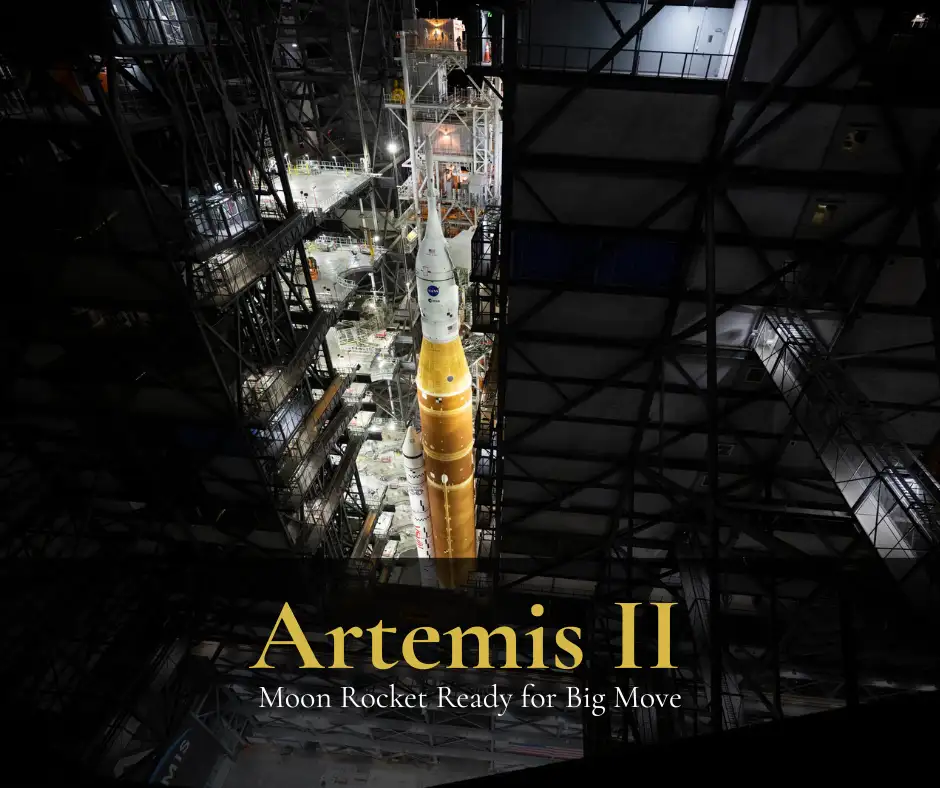
For the first time since the Apollo era, humans are preparing to leave the safety of low Earth orbit not for spectacle, but for validation.
Artemis II is not a moon landing. It is something more fundamental: a full-scale, human-rated systems test in deep space. If it succeeds, it proves that modern spaceflight can move beyond Earth again in a sustainable, repeatable way. If it fails, everything that follows pauses.
This mission quietly carries the weight of the next half-century of human exploration.
Artemis II: Not a destination mission, a credibility mission
Artemis II will send a crew aboard the Orion spacecraft, launched by the Space Launch System (SLS), on a free-return trajectory around the Moon. The spacecraft will travel farther from Earth than any crewed vehicle in over 50 years, then return without landing.
That choice is deliberate.
NASA is not chasing headlines. It is chasing verification:
Can modern life-support systems sustain humans outside Earth’s magnetic shield?
Can guidance, navigation, and propulsion systems operate reliably over lunar distances?
Can Orion survive a high-energy re-entry at velocities unmatched since Apollo?
Every answer must be earned, not assumed.
Artemis II: Why deep space is fundamentally different
Low Earth orbit is forgiving.
The Moon is not.
Beyond Earth’s protective magnetosphere, astronauts are exposed to:
continuous cosmic radiation
solar particle events
thermal extremes
communication delays
No software update or ground intervention can “fix” problems in real time. Systems must work as designed, under stress, with humans on board.
Artemis II is the first time this entire architecture is tested together, end-to-end, with lives at stake.
Artemis II: Orion is not Apollo and that matters
Comparisons to Apollo are inevitable — and misleading.
Orion is built for:
longer missions
higher radiation tolerance
autonomous fault detection
digital fly-by-wire flight control
Its heat shield must withstand re-entry energies higher than Apollo ever experienced, because Orion returns faster. This is not heritage engineering — it is validation of new materials, new modeling, and new safety margins.
Artemis II is where theory meets physics.
The SLS question
The SLS is often discussed in political or budgetary terms. Artemis II reframes the conversation.
Technically, SLS is designed for:
lifting heavy, crewed spacecraft beyond Earth orbit
deep-space injection trajectories
human-rated safety redundancy
Artemis II is the first time these claims are tested with astronauts aboard. Performance here is not symbolic — it determines whether SLS is a viable backbone for sustained exploration.
Human factors matter as much as hardware
Beyond propulsion and heat shields, Artemis II evaluates the human system.
The mission will generate data on:
crew performance under prolonged isolation
cognitive load in deep-space operations
sleep, stress, and decision-making without real-time Earth support
These factors become critical when missions stretch from days to months — and eventually, years.
The Moon is the proving ground. Mars is the reason.
Why Artemis II doesn’t age with headlines
Launch dates will change.
Timelines always do.
But Artemis II’s relevance is structural, not temporal. It answers questions that remain valid regardless of calendar year:
Can humans safely operate beyond Earth orbit again?
Can modern engineering close the risk gap Apollo accepted?
Can deep-space missions be repeatable, not heroic one-offs?
These are not news questions. They are civilization questions.
What success really means
A successful Artemis II does not mean celebration — it means permission.
Permission to:
attempt lunar landings with confidence
build sustained presence around the Moon
design missions that assume humans belong beyond Earth
Failure would not be dramatic. It would be quieter — delays, redesigns, reassessments. But it would remind us that deep space remains unforgiving.
Conclusion
Artemis II is the moment when ambition becomes accountable.
No flags are planted.
No footprints are left.
Instead, something more important happens: modern human spaceflight either proves it is ready — or learns why it is not.
And in exploration, that distinction defines the future.